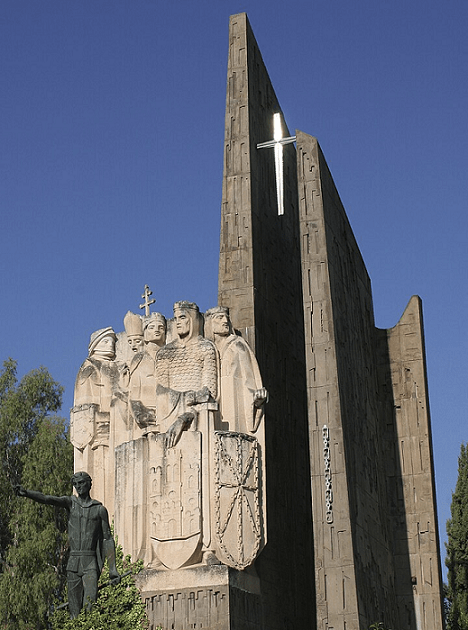
The Definitive History of the Battle of Las Navas de Tolosa
By: Carlos Vara
Translated by: Luke Wolf
From the book: Las Navas de Tolosa. Carlos Vara. Edhasa. 2012. Pages 329 – 336.
Editor’s note: The Battle of Las Navas de Tolosa is perhaps the most important conflict in the long and sordid history of Islamic domination in the Iberian Peninsula. The climatic battle took place in southern Spain and directly led to the liberation of much of Spain and Portugal from Islam. This is the definitive history of that battle, available in English for the first time.
The Battle Begins
The Christian army started moving into attack formation from their previous mountaintop position around six in the morning on Monday, July 16, 1212. Although at that time of year it was already light around 5:45, as we see 785 years later, the light was not sufficient until after six for the army to maneuver. At that time, the knights, armed, equipped, and mounted on their war horses, descended the Mesa along its southern slope, heading toward the spot now occupied by the rural house known as Mesa del Rey on the estate of Don Manuel López de Cozar, since it is precisely at this level where the slope is gentlest. We have been able to observe how this is the area chosen for mules carrying packs today, and how modern-day mules traverse the mountainside without difficulty around 6:45 at this time of year. According to our calculations, the Christian army would have already reached the plain at 7:30, and formed lines between the Navavaca road and the firebreak that starts at the slope of the Mesa del Rey and ends in the village of Miranda del Rey.
The Arab light cavalry, and the Turkish archers in particular, conveniently positioned on the hill of Canadillas del Calvario, must have harassed the descent and formation of the Christian army with a shower of arrows. This assertion is based on the fact that, although not as numerous as in other places, arrowheads have been found from the Calvario fountain to the Quinones de Miranda. The Christian vanguard was organized in a small valley below the mesa, and this vanguard opposed the Muslim army.
Thus, the Christian troops turned towards the west and after crushing the first lines of Islamic volunteers, they ascended towards the plain of Las Americas, crossing the line of the current road between Miraanda and the Navavaca road.
The Christian army of mounted men, without breaking formation, crossed the Plain of the Americas, while the Arab cavalry, harassing them all the way, attempted to disrupt it. Upon reaching the Cerro de los Olivares, the Christian vanguard encountered the well-formed Almohad troops in square formation. As one chronicler notes:
The Moorish drums sounded with a roar, and the Saracens stopped their march, and not only did they resist our men, but they attacked them with such vigor that the mountain people, who were from the kingdom of Castile, turned their backs and fled, both horsemen and foot soldiers, so that almost the entire army that was there before the Islamic wave, except for some Spanish nobles and soldiers from beyond the mountains, seemed to be fleeing.
The Latin Chronicle recounts the development of this phase of the battle with these words:
They attack each other, fighting everywhere, close quarters, with lances, swords, and maces, and both sides’ archers are nullified; the bowmen stand dumbfounded as the men on the plain fight hand to hand, so close they can grab the enemy by the belt. The Christians persist, the Moors resist, and the roar and clash of arms ensues. The fighting continues, with neither side defeated, although at times it looks as if the battle could go either way. On some occasions, cries are raised by some wounded Christians who have succumbed to the Muslim swords.
The Christian attack faced moments of great difficulty because they were fighting on a steep slope, always uphill, while the Almohads held the heights. The Christian front ranks broke, and some nobles were isolated, surrounded by the Almohads.
The second line, made up of the Christian military orders such as The Knights Templar along with some barons, all of whom were commanded by the Lord of Cameros, sought to prevent the Islamic front line from breaking through. During this phase of the battle, there were high casualties among the Christians, especially among the cavalry orders, who were badly damaged by this downhill onslaught as the wall of Islamic horsemen waved into the drowning Christian calvarymen, who were brought down choking on the contested dirt, true to their vows. The Almohad cavalry, and possibly also the Andalusian cavalry, pursued the retreating Christian troops, riding them down, trampling them like calves in a stampede. A primary source outlines what happened:
The noble Alfonso, realizing the Christian line was in danger of breaking and observing that some, with villainous cowardice, were not fighting with all they had, said in front of everyone to the Archbishop of Toledo: “Archbishop, let us die here, me and you!” The Archbishop replied: “By no means; If we die, who will prevail against the enemy?” In turn, the king, without losing his spirit, said: “Let us rush to the aid of the front line, which are in danger!” Then Gonzalo Ruiz and his brothers advanced towards the front line; but Fernando Garcia, a man of valor and experienced in war, detained the king, advising him to provide assistance from behind the main battle lines and thus the Christians were able to stabilize the threatened front, preventing a collapse.
It was precisely at this moment that the Almohads committed a serious tactical error: they broke their formation with the intention of catching up with the retreating Christians, spreading themselves dangerously thin, without taking into account that the Christian reserves, commanded by the king and queen, still remained. On this occasion the king waited for the opportune moment to act, thanks to the warnings of Fernando García and the Archbishop himself. Contemporary accounts pick up the story:
Then the king said: “Archbishop, let us die here. For death in such circumstances is no disgrace!” And the Archbishop replied: “If it be God’s will, the crown of victory awaits us, and not fate; but if it be not God’s will, we are all ready to die with you!”
And then, when the Christian reserve entered the battle, attacking the overstretched Muslims, both the Almohad front and rear were broken. The Christians taking out small groups of Saracens one by one, the way dominoes fall one after another. According to Ibn Abi Zar: “The Andalusian leaders fled with their troops, due to the hatred in their hearts toward caliph Al Nasir, caused by the death of Ibn Qadis and the threats directed at them by Ibn Djami.”
The Christian troops then found themselves before the Caliph’s wooded fortified enclosure, located on the Cerro de las Vinas. The confrontation with the Caliph’s guard took place on the gentle slopes. The attack on the last Almohad position must have been almost synchronized between the three Christian army corps. The Aragonese and Navarrese closed the pincers around the enemy and then squeezed.
Later, both Aragonese and Navarrese sought to capitalize on the significance of the capture of the Caliph’s palisade. Argote de Molina claims that Aznar Pardo, precisely for having set fire to the Moorish wooden fort, adopted three green brands with red flames on a gold field as his heraldic arms. Don García Romero, for his part, changed his coat of arms, replacing a black eagle on a silver field with three chained gold stakes on a red field.
According to the Castilian version, it was Don Alvaro Nunez de Lara, Second Lieutenant of Castile, who, on horseback, assaulted the Islamic palisade.
However, in popular opinion, Sancho the Strong, King of Navarre, remains the main protagonist of the breach of the Caliph’s palisade, adopting the chains that surrounded the fortification as his coat of arms. These chains are still preserved today in Roncesvalles and, according to tradition, are the same ones that connected the stakes that formed the wooden enclosure. Remnants of these chains are also preserved on the façade of Plasencia Cathedral.

The greatest difficulty in taking the fort lay in overcoming the human wall that formed the caliph’s guard, surrounded by a veritable forest of spears: “Then they turned the rumps of their armored horses against the spears of the black men directed at them, and entered their ranks, fighting the whole way.”
This succinct description is the only one that has survived of the capture of the red tent of the Islamic king; the Archbishop described that moment with the following words:
And being unable to bear the danger of the first lines any longer, the Christian knights started fighting with renewed vigor, cutting down the last of the guards in their way and joyfully brought the banners of God to the platform of the Muslim king by the Lord’s command. The cross of the Lord, which was usually waved before the Archbishop of Toledo, miraculously passed between the ranks of the Muslims, carried by the Canon of Toledo, Domingo Pascasio, and there, just as the Lord wished, it remained until the end of the battle, without its bearer suffering any harm.
I (Carlos Vara) believe that in this phase of the battle, the heavy cavalry charged the guard. This is undoubtedly the only way to overcome a human barrier of similar characteristics, since a horse, launched into a gallop, even if killed by the first row of lances, by virtue of its inertia, is a moving body colliding with another and will knock down spearmen who oppose it. An armored horse weighed about 800 kilos (1,763 pounds), and when launched into a charge, it acquired remarkable strength. It is known that runaway horses can, in their own right, break through fairly thick walls and iron railings. Experience confirms that any charge that comes within range of the bayonet is almost always successful.
Until that moment, Al-Nasir, wearing the black cloak, and holding the Quran, had been observing the progress of the battle from the red tent of the king. The Archbishop relates: “then the king of the Muslims, at the request of his brother, Zeyt Avozecri, resorted to flight on the back of a horse and reached Baeza, accompanied in danger by four horsemen.” Ibn Abi Zar comments on this passage in a similar way:
Al-Nasir remained seated upon his platform in front of his tent, saying, “God spoke the truth, and the devil lied,” without moving from his place until the Christians came to him, killing his guards right in front of the caliph’s eyes. More than 10,000 of those who formed his guard died; then, an Arab, mounted on a mare, approached him and said, “How long will you continue to sit? O Prince of the Faithful! God’s judgment has been fulfilled, His will has been accomplished, and the Muslims have perished.” Then Al-Nasir rose to mount the swift stallion that was beside him; but the Arab, dismounting from his mare, said to him, “Mount this one, for she is of pure blood and suffers no disgrace; perhaps God will save you with her, for our good lies in your salvation.” Al-Nasir mounted the mare, and the Arab on his horse preceded her, both of them surrounded by a strong detachment of black men; and the Christians were close enough to reach out and touch them.
“The Muslims turned their backs and defeat spread among them like a pestilence. Al-Nasir held his ground with such firmness that he was on the verge of being killed and captured by the enemy, so much so that the Christian frontline reached him; then he fled and was saved.” With Al-Nasir’s flight, the final stage of the battle began: the pursuit.
The Muslim army was defeated and had no reserves left. In this phase, the final strategy was pursuit of the fleeing Muslims. The Christians, then, crossed the Muslim camps located on the southeastern slope of the Cerro de las Vinas, heading towards the present-day town of Santa Elena. According to the Archbishop of Narbonne, the Muslims themselves, in their flight, knocked down their own tents. The knights and military orders bravely continued their pursuit of the fleeing enemy, following the orders of the Bishop of Toledo, who had prohibited plundering under threat of excommunication. However, the same exemplary conduct was not observed by some of the knights of Aragon and the foot soldiers, who attempted to seize the loot.
The pursuit took place for about thirteen miles, in the direction of Vilches: “Who could explain how many corpses the Christians had killed in the pursuit? There were too many to count.” In any case, the troops who participated in the pursuit must have been returning around nine o’clock in the evening. There were approximately 33,000 to 49,000 men from both armies present on the battlefield. The exact numbers are impossible to confirm, as are the precise number of casualties. But regardless of the numbers involved, the Christians won and Iberia, and perhaps Western Civilization, is what it is today because of the victory at Las Navas de Tolosa.


 Battlecast